The Ultimate Guide to Material Handling Equipment
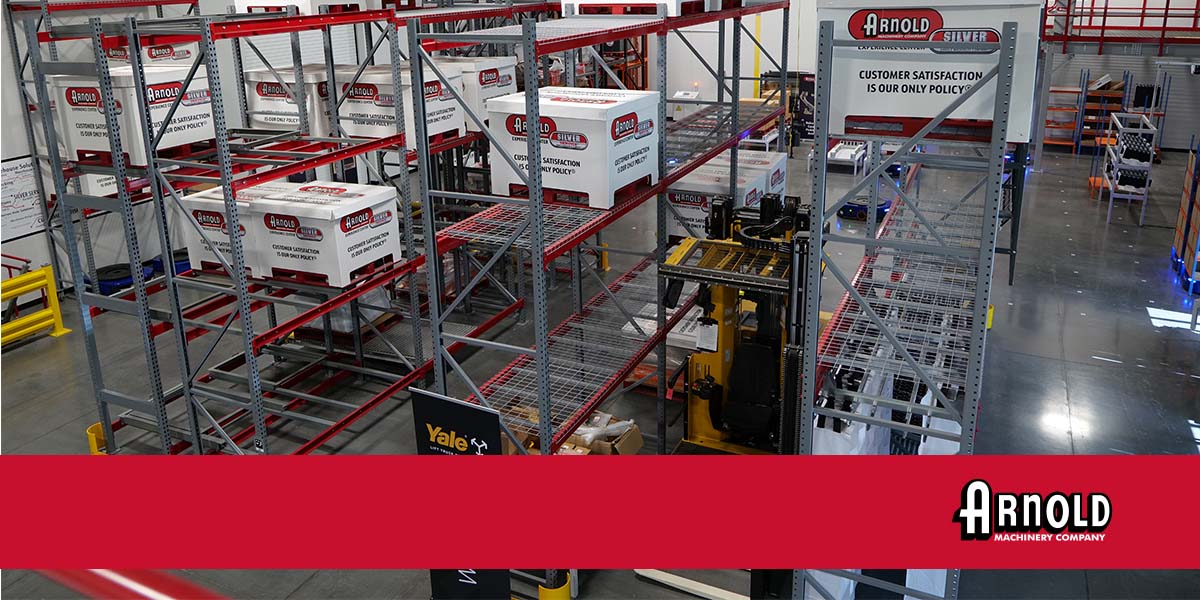
Running a warehouse, distribution center, or manufacturing facility means keeping products moving efficiently. That starts with having the right equipment in the right place, and a single bottleneck, like a slow forklift or a cramped aisle, can throw off an entire day’s workflow.
Material handling equipment spans a wide range of equipment and systems, from simple hand trucks to fully automated retrieval systems. Figuring out what fits your operation can feel like a lot to sort through, but understanding the basic categories makes the decision far more manageable.
This guide breaks down what material handling equipment is and the main types you’ll encounter. It also covers the most common hazards, safety practices that help keep your crew protected and practical tips for getting the most out of your equipment.
What Is Material Handling Equipment?
Material handling equipment (MHE) refers to the tools, machinery, vehicles and systems used to move, store, protect and control materials and products. MHE is invaluable throughout production, distribution, warehousing and disposal processes.
Beyond simply moving product from point to point, proper equipment improves operational efficiency, protects workers from injury, reduces labor costs and minimizes product damage during handling and storage. These benefits compound as an operation grows, which is why selecting handling equipment thoughtfully pays off well beyond the initial purchase.
Material handling equipment supports a wide range of industries, including:
- Manufacturing: Manufacturing facilities use material handling equipment to move raw materials and finished products between production stages.
- Warehousing: Storage facilities rely on racking, shelving and lift equipment to organize inventory efficiently.
- Distribution: Distribution centers depend on conveyors, forklifts and sortation systems to keep orders moving.
- Construction: Jobsites use rough-terrain forklifts and cranes to move heavy materials across uneven terrain.
- Food and chemical production: These industries often require specialized bulk-handling equipment to manage loose or sensitive materials.
Types of Handling Equipment
Every operation has its own layout, product mix and pace of work, but most material handling needs fall into four broad categories.
Storage and Handling Equipment
Storage and handling equipment refers to systems used to hold, organize and protect materials during periods of rest between moves. Common types of storage and handling equipment include:
- Pallet racking systems: Selective racking is among the most common pallet racking solutions and can be configured as a double-deep setup to achieve double the storage density. Push-back racking uses carts and rails for a last-in, first-out (LIFO) storage approach, while pallet flow systems use rollers for a first-in, first-out rotation. Cantilever racking works well for long or bulky materials such as lumber and pipes.
- Industrial shelving: Modular drawer units, rivet-style shelving and steel clip shelving give facilities flexible options for organizing smaller or irregularly shaped items.
- Mezzanine platforms: These elevated structures create additional usable square footage within existing floor space, often for storage, offices or light assembly work.
- Wire enclosures: These partitioned areas secure valuable or sensitive inventory while maintaining visibility and airflow.
- Dock equipment: This category includes yard ramps, dock boards and plates, levelers, vehicle restraints, dock seals, shelters, bumpers and wheel chocks, all of which support safe and efficient loading and unloading.
Choosing the right pallet racking systems involves balancing density, or how much product you can store, against selectivity, or how easily you can access individual items. An experienced dealer can evaluate your operation and help determine the ideal configuration.
Bulk Material Handling Equipment
Bulk material handling equipment includes systems designed to move, store or control large volumes of loose, unpackaged goods such as grains, minerals, liquids, aggregates, powders and chemicals. This equipment differs from general storage equipment, which typically handles packaged or palletized unit loads rather than loose, high-volume materials.
Common types of bulk material handling equipment include:
- Conveyor belts: Often considered the backbone of bulk transport, industrial conveyor systems move materials continuously along a fixed path.
- Hoppers: These funnel-shaped containers collect materials and release them on demand, acting as a control point in the handling process.
- Bucket elevators: This equipment carries materials vertically between facility levels, making it useful for multi-story operations.
- Stackers: Stackers pile bulk materials into organized storage formations.
- Reclaimers: Reclaimers retrieve previously stacked materials for further processing or transport.
Industries that rely most heavily on bulk material handling equipment include mining, construction, food and chemical production, manufacturing and distribution.
Industrial Trucks
Industrial trucks are powered or manual vehicles used to transport materials within a facility or across a worksite. Common types of industrial trucks include:
- Counterbalance forklifts: These are the standard choice for many operations, especially in indoor, controlled environments.
- Reach trucks: These vehicles extend their forks forward to access deep racking in narrow aisles and offer a smaller turning radius than standard counterbalance forklifts.
- Order pickers: These machines lift operators to picking height, streamlining the process of retrieving individual items from elevated storage.
- Pallet jacks and pallet trucks: Built for short-distance moves, these handle lighter loads efficiently.
- Tow tractors: These vehicles pull multiple carriers at once, useful for moving several loads in a single trip.
- Side loaders: Designed for long or wide loads, side loaders handle materials that standard forklifts struggle to maneuver.
- Rough terrain forklifts: Built for outdoor use, these forklifts handle uneven surfaces that would challenge standard indoor models.
- Turret trucks: These specialized trucks operate in ultra-narrow aisles, maximizing storage density in tight warehouse layouts.
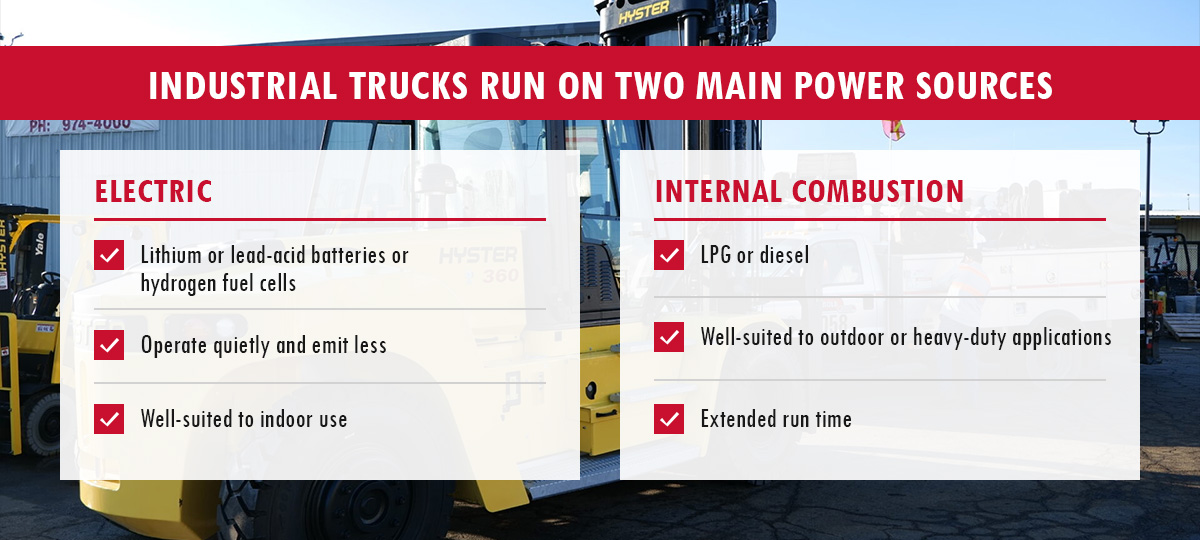
Industrial trucks run on two main power sources. Electric trucks run on lithium or lead-acid batteries or hydrogen fuel cells. Electric models tend to operate quietly and emit less, making them well-suited to indoor use. Internal combustion trucks run on LPG or diesel and are well-suited to outdoor or heavy-duty applications where extended run time matters most. The right power source for a forklift depends on the application and environment. Some fleet managers keep a mix of both to cover different jobs across their facilities.
Engineered Systems and Advanced Material Handling
Engineered systems combine multiple pieces of equipment into automated or semi-automated setups that manage material flow with minimal manual intervention. Common types of engineered systems include:
- Advanced conveyor systems: These include belt, roller, gravity and overhead configurations that move materials along complex paths.
- Automated storage and retrieval systems (AS/RS): These systems use floor-to-ceiling racking paired with automated retrieval equipment to optimize product density, enabling mixed-pallet picking and precise pallet sequencing.
- Autonomous mobile robots (AMRs): Unlike AGVs, AMRs navigate dynamically, adjusting their paths based on real-time floor conditions.
- Automated guided vehicles (AGVs): These vehicles follow predetermined paths to transport materials without a human operator at the controls.
- Sortation systems: These systems automatically route products to the correct destination based on programmed criteria.
- Vertical lift modules: Vertical storage solutions bring inventory directly to the picker, protecting goods in enclosed compartments while freeing open floor space.
The primary goal of warehouse automation is to increase efficiency, reduce errors and improve overall productivity. Automation also helps managers address labor shortages and scale output without a proportionate increase in headcount. Equipment in this category may incorporate advanced features such as real-time inventory tracking and often integrates with existing warehouse management systems.
Material Handling Hazards and Safety
Material handling equipment dramatically improves operational efficiency. However, it also introduces significant risks when operators lack proper training, equipment goes without maintenance or workplace controls fall short. For instance, forklifts were linked to 84 work-related deaths in 2024, a reminder that safety is nonnegotiable for anyone operating or managing material handling equipment.
Common Material Handling Hazards
Material handling hazards show up in predictable patterns across most facilities, and awareness is the first step toward addressing them. Common hazards include:
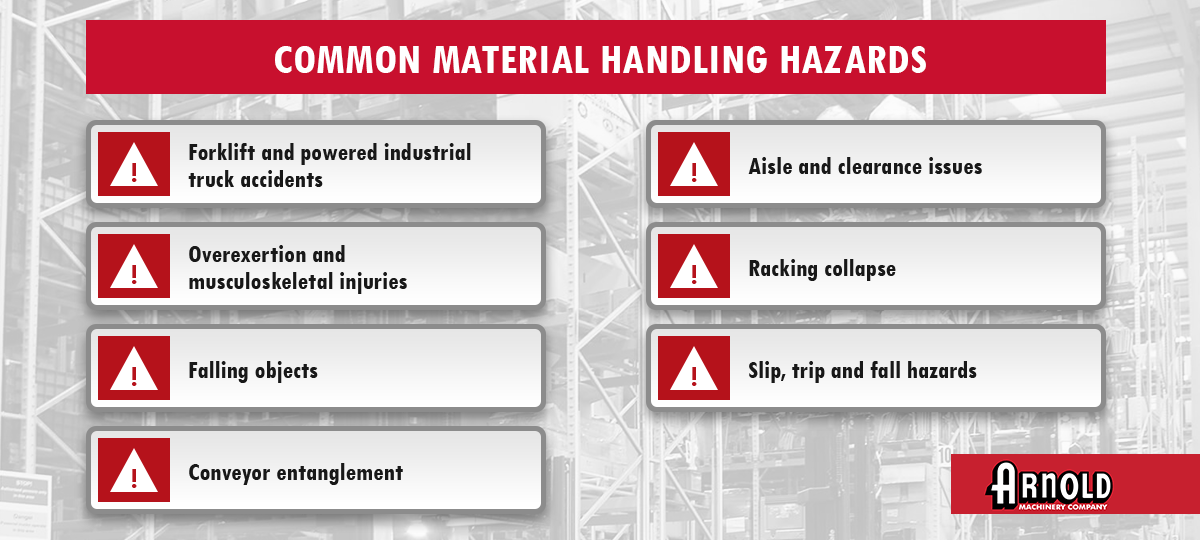
- Forklift and powered industrial truck accidents: Tip-overs, struck-by incidents and falls at loading docks account for a large share of material handling injuries.
- Overexertion and musculoskeletal injuries: Lifting, twisting and repetitive motion during manual handling place ongoing strain on workers’ bodies. The Bureau of Labor Statistics found that overexertion, repetitive motion and bodily conditions caused the most Days Away, Restricted or Transferred (DART) cases across private industry, totaling 946,290 incidents between 2023 and 2024.
- Falling objects: Improperly stacked or unsecured materials can shift or topple without warning.
- Conveyor entanglement: Caught-in hazards occur when clothing, hair or someone’s limbs get too close to moving parts, leading to an accident.
- Aisle and clearance issues: Obstructions and insufficient clearances create collision risks and make it harder for equipment and workers to move safely through a facility.
- Racking collapse: Overloading or structural damage can cause racking systems to fail, endangering anyone nearby.
- Slip, trip and fall hazards: Cluttered aisles and wet floors create everyday risks that are easy to overlook.
Under OSHA’s general materials handling standard, facilities need to leave enough open space for safe movement around aisles, loading docks, doorways and any spot where equipment has to turn or pass through.
Moreover, all material handling equipment has a rated capacity, and it should stay within those limits at all times. Racking also needs regular inspection and maintenance, with any damaged sections immediately isolated until repairs are made.
Material Handling Safety Best Practices
Here are a few essential practices to help you minimize material handling hazards in your facility:
- Train and authorize every operator: OSHA requires forklift operators to complete training and evaluation under 29 CFR 1910.178, with recertification required at least every three years or sooner if unsafe operation is observed.
- Conduct pre-operation inspections: Check equipment before each shift to catch problems before they become incidents.
- Respect rated load capacities: Every piece of equipment has a maximum safe weight limit that protects both the operator and the load.
- Keep aisles marked and clear: OSHA requires permanent aisles and passageways to stay appropriately marked and free of obstructions.
- Stack and secure materials properly: Stacking, blocking, interlocking and limiting height help keep stored materials stable.
- Follow lockout and tagout procedures: These steps protect workers servicing conveyor systems from unexpected equipment startup.
- Install and test emergency stops: Emergency stop buttons, light curtains and speed controls are key safety layers for conveyor equipment.
- Maintain ongoing training programs: Regular refreshers keep safety knowledge up to date as equipment and processes evolve.
- Apply ergonomic handling techniques: Raising pallets to reduce bending, using mechanical stretch wrappers and providing anti-fatigue mats can help reduce physical strain.
Tips for Getting the Most Out of Material Handling Equipment
Having the right equipment is only part of the equation. How you use and manage that equipment daily determines the real return on your investment. Consider these practical tips:
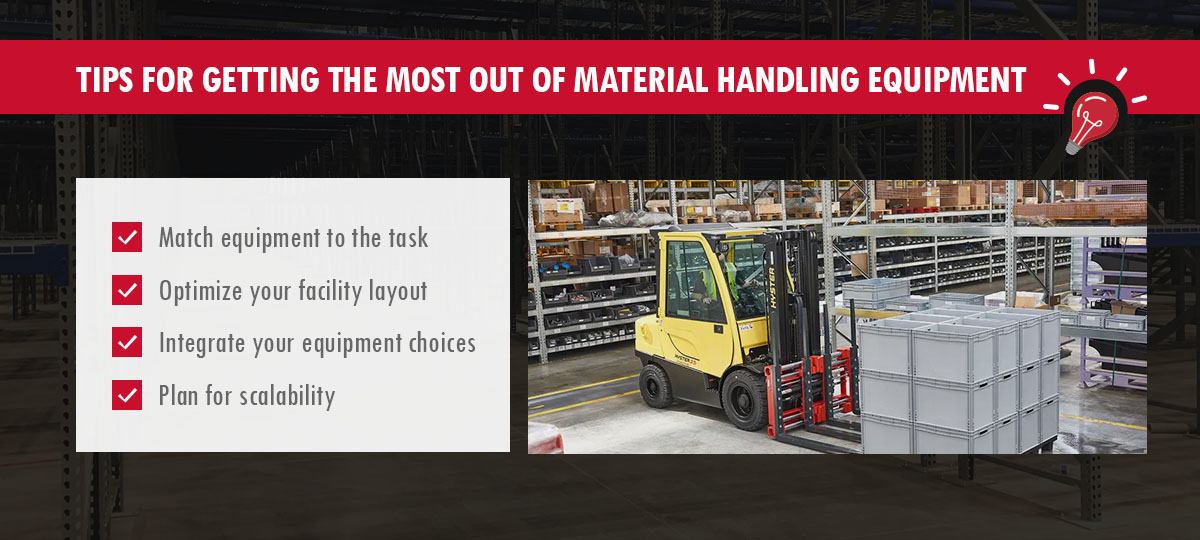
- Match equipment to the task: Choosing the right material handling equipment for your specific application pays off in both daily performance and long-term reliability. Factor in load type and weight, travel distance, environment and frequency of use before selecting equipment.
- Optimize your facility layout: Aisle widths, ceiling heights, floor conditions and traffic patterns all affect which equipment works best, and reducing unnecessary travel distance improves throughput while maximizing cubic footage.
- Integrate your equipment choices: Think about how each piece of equipment interacts with your overall workflow rather than evaluating tasks in isolation.
- Plan for scalability: Choose equipment that can grow alongside your operation to avoid the need for costly replacements as demand increases.
Keeping your equipment in good working order through regular preventive maintenance protects both your investment and your workforce over the long run.
Which Type of Material Handling Equipment Does My Facility Need?
The type of MHE your facility needs depends on your daily workflow. A distribution center moving palletized goods in and out all day typically relies on storage and handling equipment paired with forklifts. On the other hand, a food or chemical plant that handles loose ingredients needs bulk material handling equipment, such as hoppers and conveyors, instead. Operations juggling high-order volumes with a tight labor pool often get the most value from engineered systems that handle repetitive picking and sorting on their own.
A useful way to narrow it down is to walk through your facility from receiving to shipping and note where materials slow down, pile up or require extra hands. Those pressure points usually indicate the type of equipment worth prioritizing first.
Get the Right Material Handling Equipment With Arnold Machinery Company
Whether you need storage and racking systems or industrial trucks and fully engineered automation, the right material handling equipment will shape how smoothly your facility runs. Equally important is how you use the equipment. Trained operators, routine maintenance and safe handling practices protect your crew while keeping equipment running at its best.
Arnold Machinery Company has supported businesses across the Western United States for over 95 years, distributing and servicing equipment across multiple industries. Our material handling division has spent more than 80 years focused specifically on the equipment that warehouses, distribution centers and manufacturing facilities rely on every day.
We offer the full range of equipment, from forklifts and industrial trucks to racking and warehouse automation. We also provide warehouse design support, on-site consultations and expert service and repair.
Our Silver Service® guarantee backs every project we take on. In other words, we are committed to doing everything reasonable and ethical to keep our customers satisfied, because Customer Satisfaction Is Our Only Policy®. With locations spanning Idaho, Wyoming, Colorado, Utah, Nevada and Arizona, help is always close by.
Browse our material handling equipment inventory to see what’s available, or contact our team online to find the right equipment for your facility.
Subscribe for Updates